Horse Racing Betting Glossary: Every Term a UK Punter Needs
 Available in US

A Glossary Built for the Betting Ring, Not the Library
Racing has its own language, and if you have ever felt lost when someone mentions a “rag” drifting in the market or a horse being “well in” at the weights, this glossary is for you. I have compiled the terms that actually matter for betting — not an encyclopaedia of obscure turf terminology, but the working vocabulary you need to read a racecard, follow a market, and understand what people around you are talking about at the track or in an online forum.
Each definition is written from a bettor’s perspective. Where a term has specific implications for how you assess a race or place a bet, I have included that context. This is a reference you can come back to whenever a term catches you off guard.
A–D
Accumulator (Acca) — A single bet linking four or more selections. All must win for the bet to pay out. Returns compound from one leg to the next, producing large potential payouts from small stakes but with a correspondingly low probability of success.
Ante-post — A bet placed before the day of a race, often weeks or months in advance. Ante-post bets offer longer odds but carry non-runner risk: if your selection does not start, you lose your stake.
Best Odds Guaranteed (BOG) — A bookmaker policy that pays you at whichever price is higher: the one you took when you placed the bet or the Starting Price. Applies to day-of-race bets on UK and Irish racing with most major operators.
Blinkers — A hood with eye cups that restrict a horse’s rearward and sideways vision, used to improve focus. First-time blinkers carry a higher-than-average strike rate in many race categories.
Brought down — A horse that falls as a result of another horse falling in front of it. Recorded as “BD” in form figures. Not the horse’s fault and should be treated differently from a fall caused by a jumping error.
Cash out — A feature offered by bookmakers that allows you to settle a bet before the event finishes, locking in a profit or cutting a loss. The cash-out value is determined by the current market odds.
Cheltenham Festival — The premier National Hunt meeting, held over four days in March at Prestbury Park. Features 28 races including the Champion Hurdle and Gold Cup.
Conditions race — A non-handicap race where weights are set by the race conditions (age, sex, previous wins) rather than by an official rating. Often used as a trial for bigger events.
Course and Distance (CD) — Notation on a racecard indicating a horse has previously won at this course and over this distance. A strong positive indicator.
Dead heat — When two or more horses cannot be separated at the finish, the result is declared a dead heat and stakes are divided proportionally.
Double — A bet on two selections in different races. Both must win. The return from the first winner rolls onto the second selection.
Drift — When a horse’s odds lengthen (become larger) in the market, indicating weakening support. A horse that drifts from 4/1 to 7/1 is attracting less money than expected.
Dutching — Backing multiple horses in the same race with adjusted stakes so that the return is equal regardless of which selection wins.
E–L
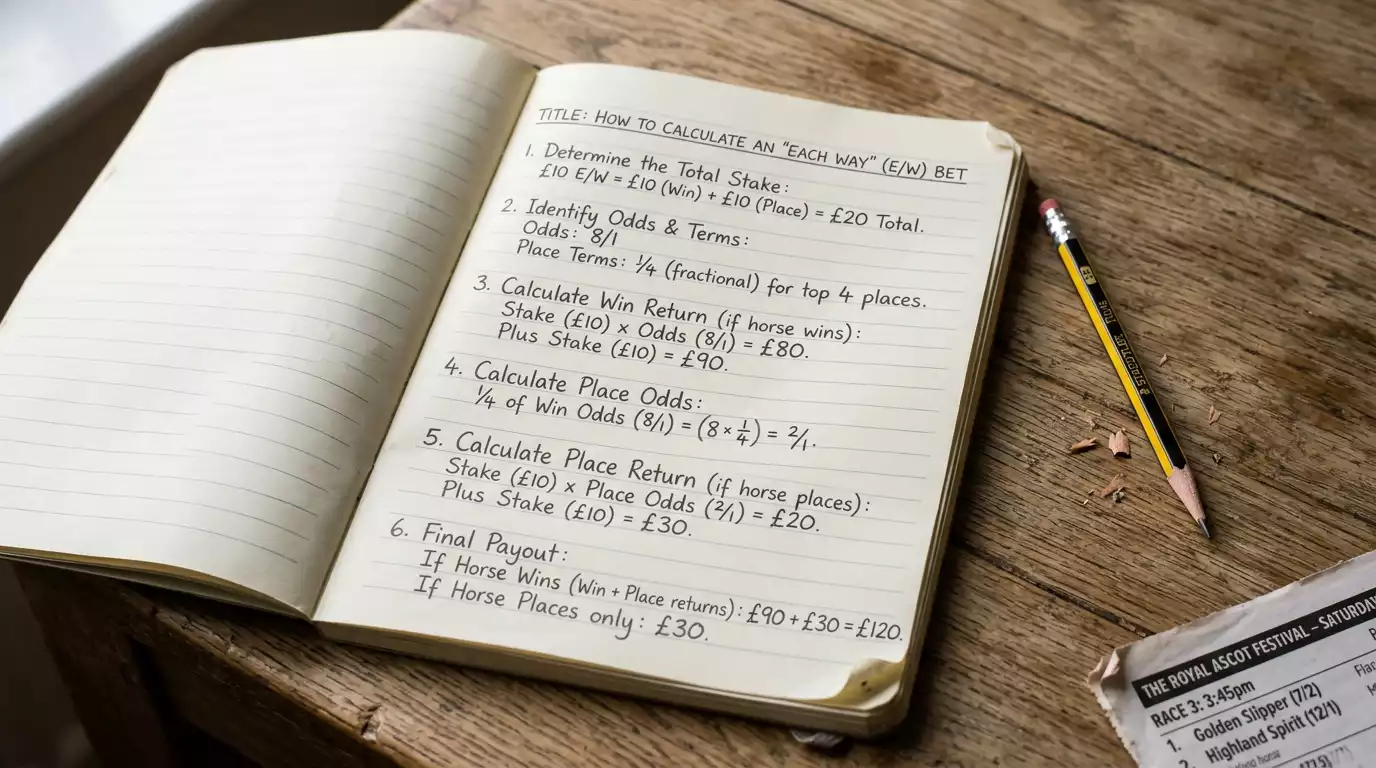
Each-way — Two bets in one: a win bet and a place bet at a fraction of the win odds. The number of places paid depends on the field size and race type.
Early price — Odds offered by bookmakers before race day or early on race day, before the market settles. Taking an early price is how you benefit from BOG.
Evens — Odds of 1/1. A winning bet at evens doubles your stake. In decimal odds, this is 2.0.
Favourite — The horse with the shortest odds in the market, judged most likely to win. Joint favourites share the shortest price.
Form figures — The string of numbers and letters next to a horse’s name on a racecard, showing recent finishing positions and non-completions.
Going — The official description of ground conditions, ranging from Hard to Heavy on turf. Going directly affects which horses are suited and how the race is likely to be run.
Going stick — A measuring device used to produce numerical readings of ground conditions, providing more precise data than the verbal going description.
Handicap — A race where each horse carries a weight determined by its official BHA rating, designed to equalise chances across the field.
In-play (live betting) — Betting on a race while it is being run. Available mainly on exchanges, with odds fluctuating based on the progress of the race.
Jolly — Slang for the favourite. “The jolly got beat” means the favourite lost.
Kelly Criterion — A mathematical formula for calculating the optimal stake based on your estimated edge and the available odds.
Lay — Betting that a horse will not win, available on betting exchanges. The layer pays out if the horse wins and collects the stake if it loses.
Lucky 15 — A permutation bet covering four selections in fifteen bets: four singles, six doubles, four trebles, and one four-fold.
M–R
Market mover — A horse whose odds shorten significantly, indicating strong support. Also called a “steamer.”
Nap — A tipster’s best bet of the day. From “Napoleon,” the card game.
Non-runner — A horse declared to run but withdrawn before the race starts. Bets on non-runners are void (stake returned) on day-of-race bets but lost on ante-post bets.
Odds-on — Odds shorter than evens, where you must stake more than you stand to win. For example, 1/2 means staking £2 to win £1 profit.
Overround — The total implied probability of all runners in a race. Always exceeds 100% because of the bookmaker’s built-in margin. A lower overround means better value for punters.
Place — Finishing in the designated positions for place payouts: first two in races of five to seven runners, first three in eight or more, first four in handicaps of sixteen-plus runners.
Pulled up (P) — A horse that was stopped by its jockey during a race, usually because of fatigue, injury, or a serious jumping error.
Rag — Slang for an outsider with very long odds that few expect to win.
Racecard — The programme listing every runner in every race at a meeting, with details including form, weight, draw, jockey, and trainer.
S–Z
SP (Starting Price) — The official odds at the moment the race begins, determined by on-course bookmakers. Used to settle bets where no fixed price was taken.
Steamer — A horse whose odds shorten rapidly, indicating heavy market support. The opposite of a drifter.
Stake — The amount of money wagered on a bet.
Tote — The UK’s pool betting operator. Bets go into a collective pool and dividends are shared among winners after a deduction.
Tongue tie — A strap holding a horse’s tongue in place to prevent breathing obstruction. Marked as “t” on the racecard.
Treble — A bet on three selections in different races. All must win.
Under Rules — Racing governed by the BHA (professional horse racing in Britain). Distinguishes it from point-to-point and amateur racing.
Value bet — A bet where the odds offered are longer than the true probability of the outcome, giving the bettor a positive expected return over time.
Visor — Similar to blinkers but with a slit in each eye cup, allowing partial peripheral vision. Marked as “v” on the racecard.
Void — A cancelled bet where the stake is returned. Bets on non-runners on day-of-race markets are voided.
Weight-for-age — A race where weights are determined by age and sex allowances rather than by official ratings. Group races and Classics are typically weight-for-age.
Yankee — A permutation bet covering four selections in eleven bets: six doubles, four trebles, and one four-fold. No singles.
Yielding — A going description used in Ireland, equivalent to roughly Good to Soft in the British scale. If you are also learning the fundamentals behind these terms, the beginner’s guide to horse racing betting puts them into practical context.
Frequently Asked Questions
What does SP mean in horse racing betting?
SP stands for Starting Price — the official odds at the moment a race begins, determined by on-course bookmakers. If you place a bet at SP rather than taking a fixed early price, your payout is calculated at whatever the Starting Price turns out to be. SP is also the reference price used by Best Odds Guaranteed policies to determine whether your early price or the SP is higher.
What is the difference between a double and a treble?
A double is a bet on two selections in different races, where both must win. The return from the first winner becomes the stake on the second. A treble works the same way but with three selections — all three must win. The potential return grows with each leg because the winnings compound, but the probability of all legs winning decreases with each additional selection.
Written by the editors at Horse bet Racing.