How to Bet on Horse Racing in the UK: A First-Timer’s Walkthrough
 Available in US
Table of Contents
- Placing Your First Horse Racing Bet Without the Guesswork
- Opening a Betting Account: What to Check Before You Sign Up
- Reading a Racecard in Under Two Minutes
- From Racecard to Bet Slip: The Step-by-Step Process
- How Much to Stake: Setting a Budget That Works
- Five Mistakes New Punters Make (and How to Sidestep Them)
- A Practical Framework for Picking a Winner
- Frequently Asked Questions
Placing Your First Horse Racing Bet Without the Guesswork
I still remember my first bet at Newbury — a fiver on a horse called something ridiculous like “Dashing Doris,” picked entirely because I liked the name. She finished ninth of ten. That was fifteen years and several thousand racecards ago, and the single biggest lesson I have learned since is that the gap between a random flutter and an informed wager is not talent — it is process. This guide exists to hand you that process on day one, so you skip the expensive trial-and-error phase I stumbled through.
Horse racing is the second-largest betting sport in the UK, generating a gross gambling yield of £766.7 million from remote wagers alone in the financial year ending March 2025. That figure tells you two things: there is serious money flowing through the market, and the infrastructure around it — bookmaker accounts, data platforms, live streaming — is built for scale. Yet 48% of British adults participate in some form of gambling over any four-week window, and most of them never go beyond picking a name or a colour. The ones who do better, even slightly, tend to follow a repeatable method rather than relying on instinct.
What follows is a practical walkthrough from zero — opening an account, reading a racecard, filling out a bet slip, sizing a stake, and building a basic framework for selecting runners. No jargon without explanation, no assumptions that you already know the difference between fractional and decimal odds. If you have never placed a bet on a horse in your life, this is where you start. If you placed one last Saturday and felt completely lost, this is where you catch up.
Opening a Betting Account: What to Check Before You Sign Up
A few years back, a mate of mine signed up with the first bookmaker he found on a search engine. Three weeks later, his account was frozen during a withdrawal request because the operator’s licence had lapsed. He got his money back eventually, but it took two months and a formal complaint. The entire headache could have been avoided with a sixty-second check before he typed in his email address.
Every legitimate operator in the UK holds a licence from the UK Gambling Commission. This is not optional decoration — it is the legal gateway to offering betting services to British residents. The UKGC register is publicly searchable, and any site worth your time will display its licence number in the footer. If it does not, close the tab.
Beyond licensing, focus on three practical criteria. First, deposit and withdrawal options: a decent bookmaker offers bank transfer, debit card, and at least one e-wallet. Second, identity verification speed — under current regulations, you will need to submit proof of identity before you can withdraw, and some operators verify at registration while others wait until the first cashout. The faster this happens, the less friction later. Third, consider the welcome offer but do not let it drive your decision. A free bet is worth nothing if the site’s odds are consistently thin or its racing coverage is limited to a handful of meetings per day. The overwhelming majority of horse racing bets in the UK are now placed online or via mobile — the digital experience is not a secondary consideration; it is the primary one.
Registration itself is straightforward: name, address, date of birth, email, and a username-password combination. You will be asked to set a deposit limit during sign-up. I always recommend doing this honestly rather than defaulting to the maximum. It takes thirty seconds and creates a guardrail you will thank yourself for later.
One more detail that catches people off guard: affordability checks. If your net deposits exceed £150 in a calendar month, your operator is required to carry out an enhanced financial check. This is a relatively new threshold — lowered from £500 in February 2025 — and it has reshaped how regular punters interact with their accounts. It does not mean you cannot bet. It means you may be asked to provide evidence of income. Knowing this upfront saves you from a surprise mid-month.
Reading a Racecard in Under Two Minutes
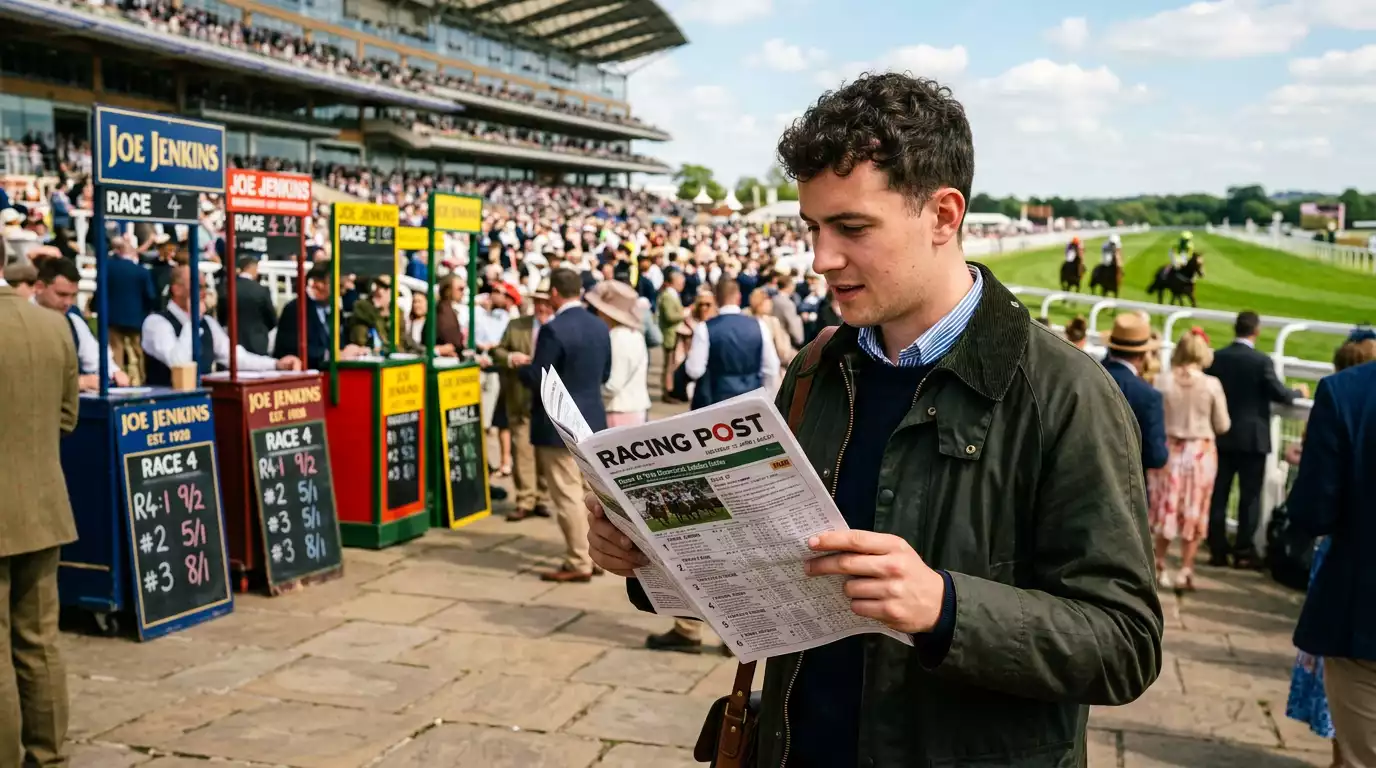
The first time I looked at a racecard I thought I was reading a spreadsheet in a foreign language. Numbers, abbreviations, tiny symbols — it felt like the racing world had built a code specifically to keep outsiders confused. It had not, of course. Once you crack the format, a racecard becomes the single most useful tool in your betting process, and you can extract what you need in less time than it takes to queue for a coffee.
A racecard is a structured summary of every horse entered in a given race. It appears online, in newspapers, and on dedicated apps. The layout varies slightly between sources, but the core information is always the same. Here is what to focus on and what to ignore when you are starting out.
The horse’s name appears alongside a number — its cloth number, which is what the jockey wears on their back and what you use when placing a bet. Next to the name you will see the trainer and jockey. These matter, but not equally in every race. For now, just note them. Beside or below the name sits the form string — a sequence of numbers and sometimes letters that represent the horse’s finishing positions in its most recent races, read from left to right with the most recent result on the right. A “1” means a win. A “2” means second. A “0” means the horse finished outside the first nine. A dash separates different seasons, and a forward slash marks a different year. Letters carry meaning too: “F” is a fall, “P” is pulled up, “U” is an unseated rider.
Below or beside the form you will find the horse’s age and weight. Age matters because younger horses improve rapidly; a three-year-old in April is a very different animal from the same horse in October. Weight is assigned by the handicapper based on official ratings, or by race conditions for non-handicap events. Higher weight is a disadvantage — the principle is simple, even if the details behind it are complex.
The going — ground conditions ranging from “firm” through “good” to “heavy” — is listed at the top of the card alongside the race distance, class, and prize money. Some horses excel on soft ground and hate firm; others are the reverse. This is one of the most overlooked factors by beginners, and one of the most profitable when you start paying attention to it.
You will also see the draw number for flat races. This refers to the starting position, and on certain courses it carries a genuine advantage. At Chester, for instance, a low draw in sprint races is a significant edge because of the tight left-handed turns.
That is the essential racecard in a nutshell. You do not need to absorb every column on day one. Start with form, going preference, and jockey-trainer combination. The rest layers on naturally as you place more bets and develop an eye for patterns.
From Racecard to Bet Slip: The Step-by-Step Process
Right, you have picked a race, studied the card, and have a horse in mind. Now what? The mechanics of actually placing a bet trip up more first-timers than anyone in the industry likes to admit. I have watched people at racecourses hand over cash and walk away without understanding what they just bought. Online, the confusion is quieter but just as real — people click buttons without grasping what their bet slip is telling them.
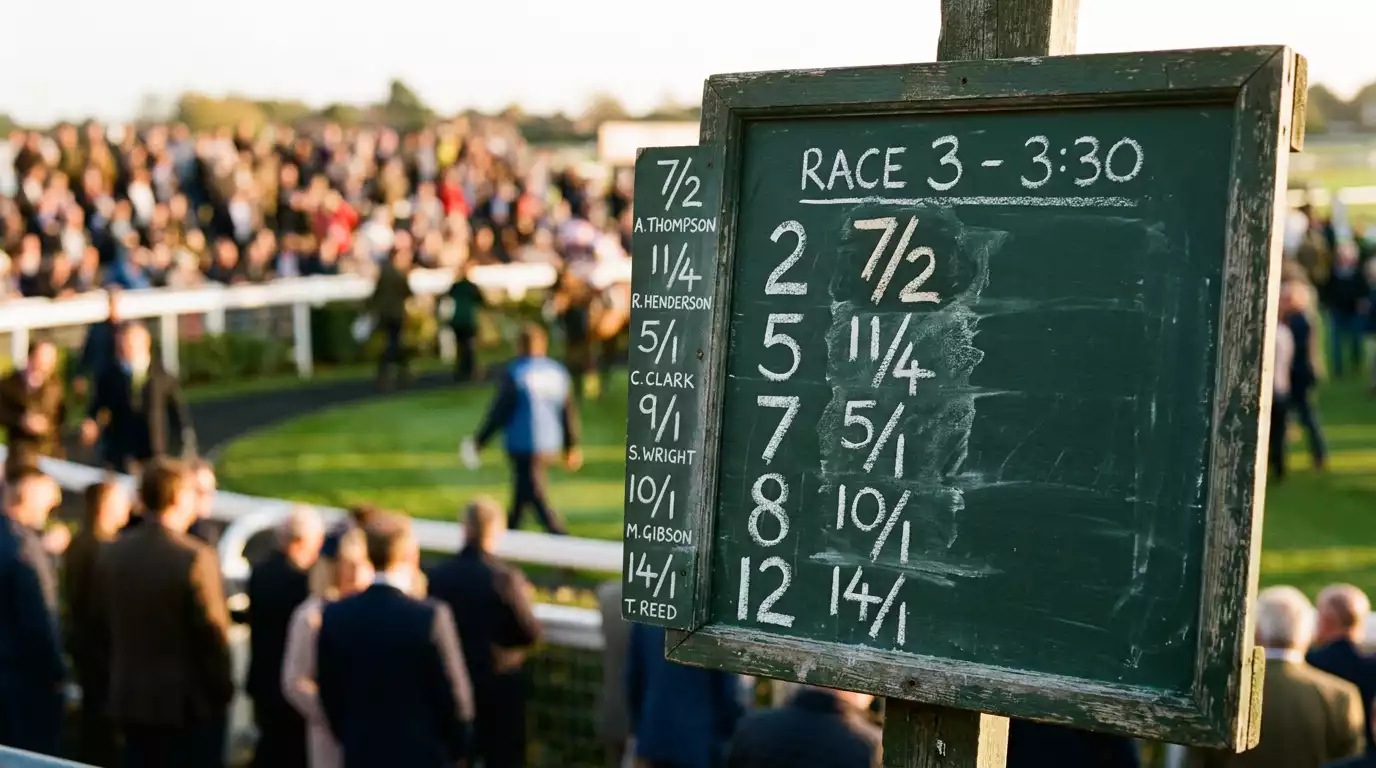
On any online bookmaker, navigate to horse racing, select the meeting (the racecourse hosting that day’s events), and click through to the specific race. You will see a list of runners with odds next to each name. Click the odds next to your chosen horse, and a bet slip opens — usually on the right side of the screen or as a pop-up on mobile.
The bet slip shows your selection, the current odds, and an empty field for your stake. The stake is how much money you are wagering. Type in your amount — say, £5 — and the slip instantly calculates your potential return. This return includes your stake, so if you see “returns £30.00” on a £5 bet at 5/1, your actual profit would be £25.
You will also see a toggle or checkbox for “each-way.” Ignore this for your very first bet. A win single — backing a horse to finish first — is the cleanest starting point. Each-way adds a second bet on the horse finishing in the places (typically top two, three, or four depending on field size), and doubles your total stake. It is a powerful tool, but there is a dedicated logic behind it that deserves its own attention once you are comfortable with the basics of win betting.
Before you confirm, check three things. One: the odds shown match what you expect. Odds can shift in the seconds between clicking and confirming, especially close to race time. Two: the stake is what you intended — fat-finger errors happen. Three: the selection is correct. I once backed the wrong horse because two names were similar and I was in a rush. It is a uniquely frustrating way to lose money.
Hit “place bet.” The bookmaker confirms the wager. You now hold a contract: if your horse wins at those odds, you get paid. If it does not, you lose your stake. Results are settled within minutes of the race finishing, and winnings appear in your account balance immediately.
How Much to Stake: Setting a Budget That Works
Here is a conversation I have had more times than I can count. Someone discovers horse racing, has a great first weekend, and then doubles their stakes on Monday because “the system is working.” By Thursday, their bankroll is gone and so is their enthusiasm. The problem was never the selection process — it was the complete absence of a staking plan.
A bankroll is the total amount you set aside specifically for betting. It is not your rent money, not your savings, not the cash earmarked for groceries. It is money you can afford to lose entirely without it affecting your life. The BHA’s own research shows that 68% of racegoers in 2025 were casual or first-time attendees, and roughly 82% of bets placed on the Grand National are £5 or less. There is nothing wrong with small stakes. In fact, small stakes paired with discipline beat large stakes paired with impulse every single day.
The simplest approach is flat staking: wager the same fixed amount on every bet, typically between 1% and 3% of your total bankroll. If your bankroll is £200, that means bets of £2 to £6. It sounds unexciting, and that is the point. Flat staking protects you from the emotional spikes that lead to reckless decisions — chasing losses after a bad run, or overcommitting after a lucky win.
Brant Dunshea, acting Chief Executive of the BHA, put it well when he said that gambling regulations should be balanced and proportionate, with those who bet safely on racing allowed to do so without interruption. That principle applies to your personal approach too. A budget is not a restriction — it is the foundation that lets you enjoy racing long-term rather than burning out after a fortnight.
Set a weekly or monthly figure. Write it down or use the deposit-limit tool your bookmaker provides. When the budget is spent, stop. This is not complicated advice, but it is the single most ignored piece of guidance in the entire sport. The punters who last are not the ones with the best tips — they are the ones who manage their money as carefully as they manage their selections.
Five Mistakes New Punters Make (and How to Sidestep Them)
I keep a mental catalogue of the errors I see repeated most often, partly because I committed every single one of them during my first year. They are not exotic mistakes. They are mundane, predictable, and entirely avoidable once you know to look for them.
The first is betting on every race. A typical UK racing day features 30 to 40 races across multiple meetings. No one — not professional analysts, not seasoned tipsters, not people who have been watching racing for decades — has a meaningful edge in all of them. Selectivity is the most undervalued skill in betting. If you only identify genuine value in two races out of a full card, bet on those two and leave the rest alone. There is no prize for activity.
The second is ignoring the going. Ground conditions change everything. A horse with sparkling form on good-to-firm ground may be mediocre on soft. Racecards list the official going, and most data sites show each horse’s record by surface condition. It takes thirty seconds to cross-reference, and it eliminates a surprising number of false favourites.
The third is chasing losses. You back three losers in a row and feel the pull to increase your stake on the fourth to “get even.” This is not a strategy — it is a well-documented psychological pattern that bookmakers understand better than you do. The correct response to a losing run is to stick to your staking plan, review your selections later, and accept that losing streaks are a mathematical certainty in any probability-based activity.
The fourth is treating odds as predictions. Odds reflect the market’s assessment of probability, weighted by the bookmaker’s margin. They do not tell you who will win. A 2/1 shot wins roughly one in three times in a perfectly efficient market, but horse racing markets are not perfectly efficient. Upsets happen. Favourites lose about 70% of the time in handicap races. Understanding this distribution stops you from feeling cheated every time a short-priced horse gets beaten.
The fifth — and this is the one that cost me the most money early on — is backing horses based on tips without doing your own work. Tips can be useful as a starting point, but they are someone else’s opinion based on criteria you may not understand or share. The moment you start verifying tips against the racecard, checking the going, and asking “why this horse?” rather than just “who do they fancy?” is the moment your betting improves dramatically.
A Practical Framework for Picking a Winner
There is no magic formula, and anyone who tells you otherwise is selling something. But there is a reliable method for narrowing a field from fifteen runners to three or four genuine contenders, and it takes less time than you think once the steps become habit.
Start with the conditions of the race: distance, going, and class. Eliminate any horse whose form string shows poor results at a similar distance or on comparable ground. If a six-furlong sprinter is entered in a mile-and-a-half race, cross it off. If a horse has never raced on heavy ground and today’s going is soft, downgrade it. This filter alone removes a third to half the field in most races.
Next, look at recent form. A horse whose last three runs read 1-2-3 is in better shape than one showing 0-8-6, all else being equal. But context matters — the 1-2-3 horse may have achieved those results in Class 5 and is now stepping up to Class 3. A horse moving up in class after strong results is interesting but risky; one dropping down in class after mediocre runs at a higher level can represent genuine value. Understanding class movement is one of the first edges a beginner can develop.
Then factor in the trainer and jockey. Certain trainers specialise in particular race types or courses. A trainer with a 25% strike rate at Cheltenham in handicap hurdles is a more useful piece of data than a trainer’s overall season win percentage. Jockey bookings matter too — when a leading jockey switches onto a horse that has been ridden by a less prominent rider, the market usually notices. More importantly, you should notice before the market does.
Finally, check the odds. If your analysis points to a horse as a strong contender and the market has it at 10/1 while you estimated its true chance at around 6/1, that is a value opportunity. If the same horse is 6/4 and you think it has a roughly one-in-three chance, it is overbet. This is where understanding how horse racing odds work becomes practically useful rather than academic.
Write down your reasoning before the race. Not because anyone is marking your homework, but because reviewing your logic after the result — whether you won or lost — is the fastest way to improve. Every professional bettor I have met keeps records. Every one of them credits that habit as the single factor that turned them from an occasional punter into a consistent analyst.
Frequently Asked Questions
What is the minimum bet I can place on a horse race in the UK?
Most online bookmakers set the minimum stake at 5p or 10p for standard bets, though some promotions and bet types may have higher minimums. At a racecourse, the minimum with on-course bookmakers varies but is typically £2. On the Tote pool, the minimum is usually £2 per line. In practice, most casual punters start with stakes between £1 and £5 per bet.
Can I bet on horse racing from my phone?
Yes. Every major UK-licensed bookmaker offers a mobile app or a fully responsive website. The functionality is identical to desktop — you can browse racecards, place bets, watch live streams (where available), and manage your account. Mobile betting now accounts for the majority of all remote wagering on horse racing in Britain.
Do I need to be at the racecourse to place a bet?
Not at all. The vast majority of horse racing bets in the UK are placed remotely — online or via mobile apps. You can bet from home, from a pub, or from anywhere with an internet connection. Racecourse betting is still available through on-course bookmakers and Tote windows, but it represents a small fraction of total turnover.
What happens to my bet if my horse is withdrawn?
If your horse is declared a non-runner before the race, your stake is returned in full. If you placed a bet in an accumulator, that leg is voided and the accumulator recalculates around the remaining selections. In ante-post markets — bets placed well before race day — non-runner refunds are typically not offered unless the bookmaker explicitly states otherwise.
Created by the ”Horse bet Racing” editorial team.