Horse Racing Betting Exchanges: How Back-and-Lay Markets Work
 Available in US
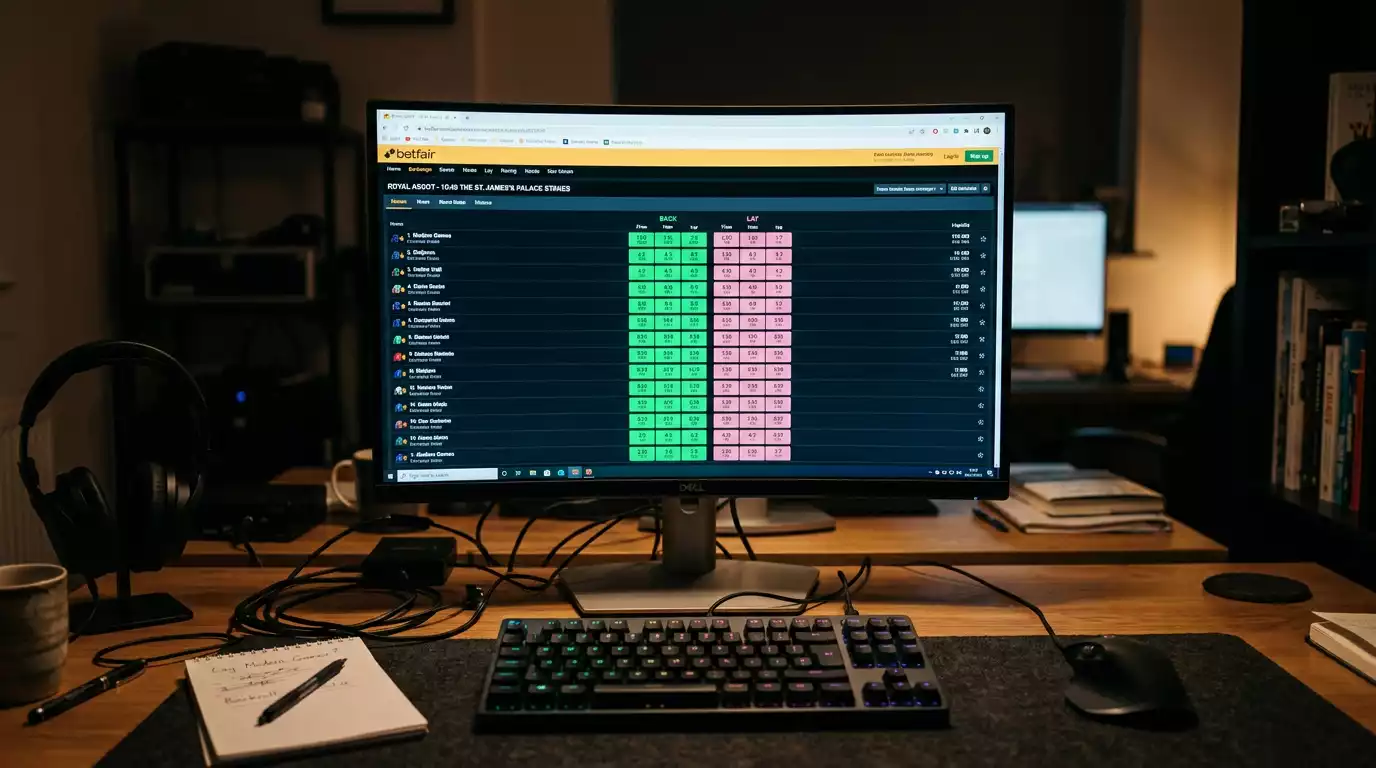
Exchanges Let You Be the Bookmaker
The day I placed my first lay bet on a betting exchange was the day horse racing betting became a genuinely two-sided activity for me. Until that point, I had only ever backed horses — hoping they would win. Laying a horse means betting that it will not win, and the moment you understand that mechanic, the entire betting market opens up in a way that traditional bookmaker betting cannot replicate.
A betting exchange is a platform where punters bet against each other rather than against a bookmaker. The exchange operator takes no position on the outcome — it simply matches backers (who think a horse will win) with layers (who think it will not) and charges a commission on the winner’s profit. Total GGY from remote betting stands at £2.6 billion, and the exchange model occupies a distinct niche within that figure, offering odds that are typically closer to true probability because there is no bookmaker margin built into the prices.
Back and Lay: The Core Mechanic
On a traditional bookmaker site, you can only back a horse — bet that it will win. On an exchange, you can back or lay. Backing works identically to a bookmaker bet: you select a horse, choose a price, and stake an amount. If the horse wins, you profit. If it loses, you lose your stake.
Laying is the mirror image. When you lay a horse, you are offering odds to another punter who wants to back it. You are effectively saying: “I do not think this horse will win, and I am willing to pay you if it does.” Your liability — the amount you could lose — is the lay stake multiplied by the odds minus one. So if you lay a horse at 5.0 (4/1 in fractional) for a £10 lay stake, your liability is £10 x (5.0 – 1) = £40. If the horse loses, you keep the £10 lay stake as profit. If it wins, you pay out £40.
The lay side is where many new exchange users hesitate, because the liability can be large relative to the potential profit. Laying a 10/1 shot at £10 means a potential loss of £90 for a £10 profit. That risk-reward ratio is the inverse of backing a longshot — and it is exactly the trade that traditional bookmakers make millions of times a day. Understanding lay betting is understanding how bookmakers think, and that perspective is valuable even if you primarily back horses.
Exchange markets display two columns: the back price (what you can back at) and the lay price (what you can lay at). The back price is always slightly lower than the lay price, creating a spread. That spread is the exchange’s equivalent of the bookmaker’s overround, and it is typically much tighter. A horse that is 4/1 with a bookmaker might be available to back at 4.6 and lay at 4.8 on the exchange. The near-absence of overround is one of the exchange’s key advantages for punters.
Commission Structures and True Cost
Exchanges charge commission on net winnings rather than building a margin into the odds. The standard commission rate varies by platform and by market but typically sits between 2% and 5% of profit. If you back a winner and your gross profit is £100, a 5% commission reduces your net profit to £95. If you lose, you pay no commission.
The effective cost of exchange betting versus bookmaker betting depends on your strike rate and the average odds you back. For punters who mainly back short-priced horses (evens to 3/1), the exchange’s tighter odds usually outweigh the commission, making it cheaper than a bookmaker. For punters who back longshots (8/1 and above), the bookmaker’s wider odds occasionally offer better value than the exchange price net of commission, because the exchange market for outsiders can be thin and the spread wider.
The levy yield from horse racing reached £108.9 million in 2024/25, and exchange betting contributes to that figure. Since 2017, exchanges that accept wagers on British racing have been required to pay the levy on their gross profits, which means exchange betting supports the sport’s funding model in the same way that traditional bookmaker betting does.
Exchange vs Bookmaker: When Each Wins on Horse Racing
I use both exchanges and bookmakers, and the division of labour has become instinctive. Exchanges win on price for popular horses in liquid markets. If I want to back the favourite in a Group 1 at Ascot, the exchange price will almost certainly beat the best bookmaker price, even after commission. The market depth is sufficient, the spread is tight, and the absence of overround delivers genuine savings.
Bookmakers win on convenience, promotions, and specific features that exchanges do not offer. Best Odds Guaranteed does not exist on exchanges. Free bet offers do not exist on exchanges. Cash-out functionality exists on some exchanges but is less sophisticated than the bookmaker versions. And for bets on outsiders in small-field races, the exchange liquidity may be so thin that you cannot get matched at a meaningful stake.
Exchanges also win on in-play betting. The ability to trade a position during a race — backing a horse pre-race and then laying it in-running to lock in a profit or cut a loss — is a powerful tool that traditional bookmakers do not fully replicate. In-play exchange markets on horse racing are fast-moving and volatile, and they reward punters who can read the race as it unfolds. I use in-play exchange trading selectively, mainly on races I am watching live where I can see a horse travelling strongly and want to lock in a partial profit before the finish.
The optimal approach for most racing punters is to maintain accounts with both an exchange and two or three bookmakers. Use the exchange for backing favourites, for laying horses you want to oppose, and for in-play trading. Use the bookmakers for each-way bets (exchanges do not offer each-way), for outsiders where the bookmaker price with BOG might exceed the exchange, and for any bet where a specific promotion adds value. Understanding when to use each tool is a core part of building an effective approach to horse racing odds and value.
Frequently Asked Questions
How does a betting exchange differ from a traditional bookmaker?
A betting exchange matches punters against each other rather than taking the opposite side of every bet itself. You can back a horse to win or lay a horse to lose. The exchange charges a commission on winning bets, typically 2% to 5%, instead of building a margin into the odds. This usually results in better prices for backers, especially on favourites, though liquidity in smaller markets can be limited.
What is laying a horse and how does it work?
Laying a horse means betting that it will not win. You offer odds to another exchange user who wants to back that horse. If the horse loses, you keep their stake as profit. If the horse wins, you pay out at the agreed odds. Your liability — the maximum you can lose — is the lay stake multiplied by the odds minus one. Laying is how bookmakers operate on every bet they accept, and exchanges give individual punters access to the same mechanic.
Prepared by the Horse bet Racing editorial staff.