Dutching in Horse Racing: How to Split Stakes Across Multiple Runners
 Available in US
Backing More Than One Horse — and Making the Maths Work
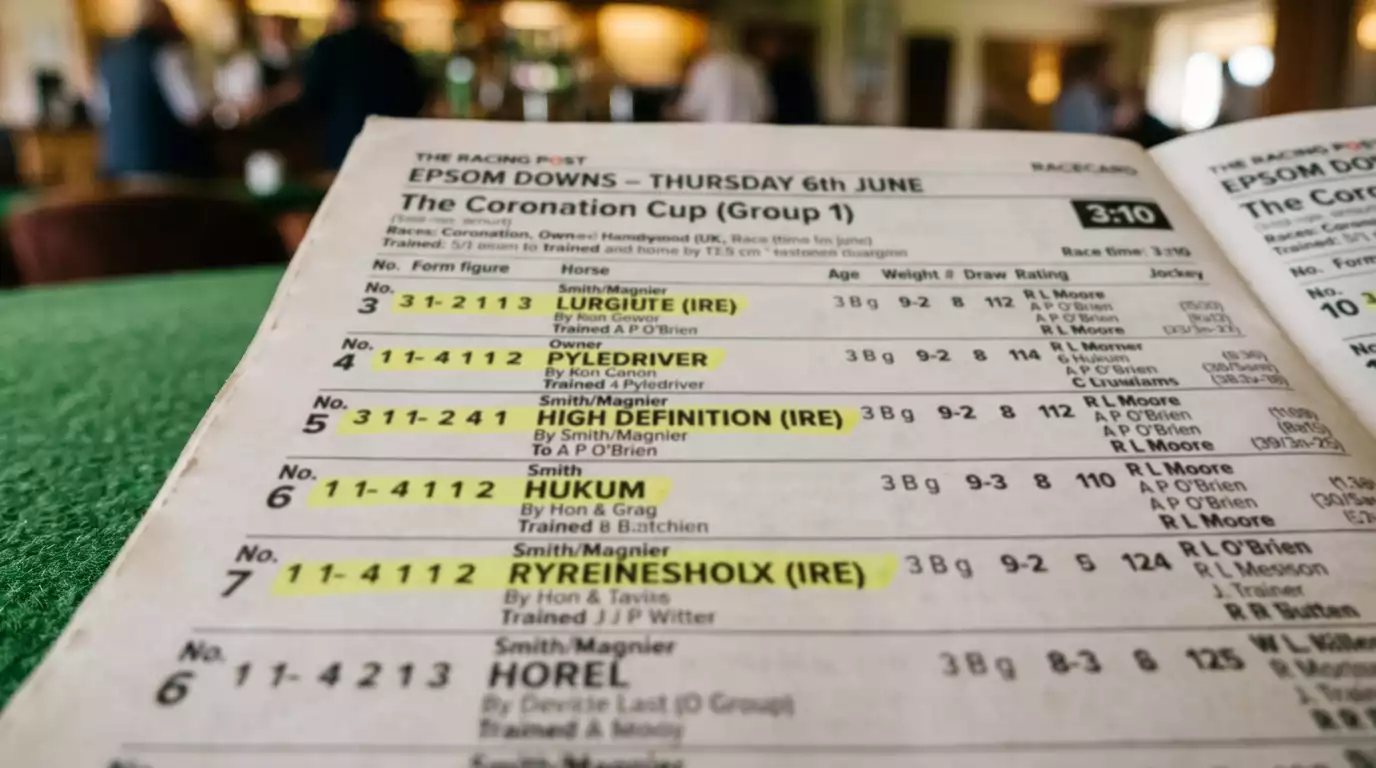
The first time I dutched a race properly, I felt like I had discovered a cheat code. It was a competitive twelve-runner handicap at Newbury, and my form study had narrowed the field to three serious contenders. I could not separate them. Instead of picking one and hoping, I spread my stake across all three, weighted so that I would make the same profit regardless of which one won. One of them did win, the maths held, and I walked away thinking: why did I not do this years ago?
Dutching is the practice of backing multiple selections in the same race with adjusted stakes so that the return is equal (or near-equal) whichever selection wins. It takes its name from Arthur Flegenheimer, a Prohibition-era gangster known as “Dutch Schultz,” who allegedly used the technique on the New York racetrack circuit. The maths has outlived the man. Horse racing participation in the UK fluctuates between 4% and 7% of the adult population depending on the time of year, and most of those punters back a single horse per race. Dutching offers a different approach — one that trades the dream of a big single-horse payout for a higher probability of a smaller, consistent return.
The Dutching Formula: Equal Profit from Unequal Odds
The principle is simple: you want to distribute your total stake across two or more runners so that the return is the same regardless of which selection wins. The execution requires a short calculation, but once you see the pattern, it becomes second nature.
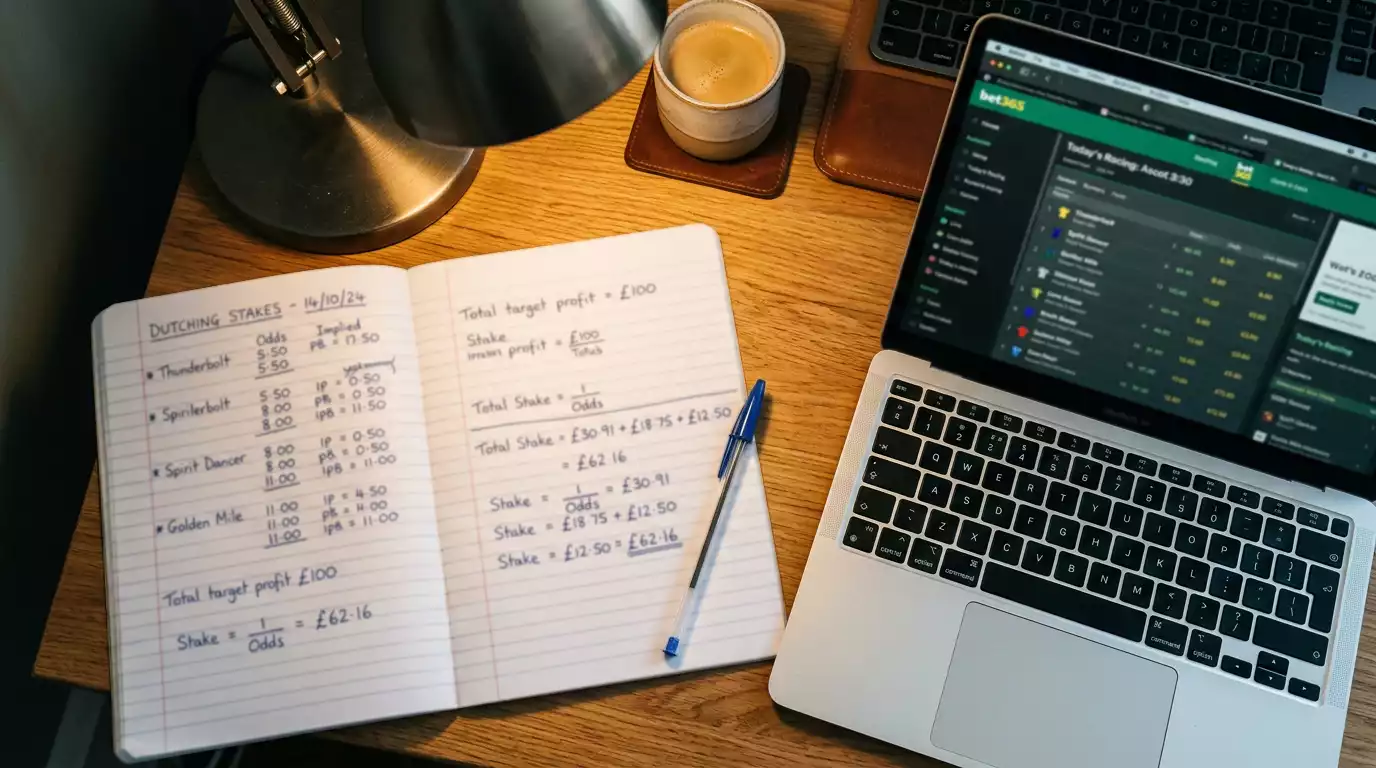
Start by converting each selection’s fractional odds to implied probability. For a horse at 3/1, that is 1 divided by (3+1) = 25%. For a horse at 5/1, it is 1 divided by (5+1) = 16.67%. For a horse at 7/1, it is 1 divided by (7+1) = 12.5%. Add up those percentages: 25% + 16.67% + 12.5% = 54.17%.
If that combined percentage is below 100%, dutching is viable — there is theoretical room for profit. Each horse’s individual stake is calculated as its implied probability divided by the total combined probability, multiplied by your total outlay. So if you want to stake £30 across the three horses: the 3/1 shot gets (25 / 54.17) x £30 = £13.85. The 5/1 shot gets (16.67 / 54.17) x £30 = £9.23. The 7/1 shot gets (12.5 / 54.17) x £30 = £6.92.
Check the return for any winner: back the 3/1 shot at £13.85. If it wins, you receive £13.85 x 4 = £55.40. Subtract your total outlay of £30, and the profit is £25.40. Do the same for the 5/1 shot: £9.23 x 6 = £55.38. Near-identical profit. The tiny rounding differences are negligible. The point is that you have constructed a position where three different race outcomes all produce roughly the same return.
When Dutching Outperforms a Single Selection
Dutching is not always the right approach. If you have a strong opinion on one horse and the odds offer genuine value, backing it as a single is usually more profitable. The former Jockey Club Chief Executive Nevin Truesdale once pointed out that regulators seemed intent on reducing gambling to small-stakes punters — and while that debate continues, the practical reality is that dutching works best precisely in the scenarios where single-bet confidence is weakest.
Competitive handicaps are the natural home of the dutch. When the top of the market sits between 5/1 and 10/1 and there is no obvious favourite, the form study often identifies two, three, or four horses that could realistically win. Backing one and watching another win is a familiar frustration. Dutching converts that frustration into structured profit.
It also works well on days when the going changes unexpectedly. I have been at meetings where the ground moved from Good to Soft between the first and third race, and my original single selection no longer looked ideal. Rather than abandoning the bet, I dutched in a second horse whose form on softer ground was stronger. The total outlay was the same, the coverage was wider, and the probability of a return was higher.
Where dutching falls down is when the combined implied probability of your selections exceeds 100%. At that point, you are overpaying relative to the odds available and the maths turns against you. In practice, the average turnover per race on Core Fixtures dropped 14.4% in early 2025 while Premier Fixtures held steady — and it is the Premier Fixture big-field races where dutching opportunities are richest, because larger fields create more competitive markets with wider price spreads.
Dutching Calculators and Practical Tools
You do not need to run these calculations by hand. A range of free online dutching calculators will do the maths for you — you enter the odds and your total stake, and the tool outputs the individual bet amounts. Some betting exchanges also offer built-in multi-bet calculators that handle dutching natively.
That said, I think it is worth understanding the formula before relying on a tool. When you know why the stakes are split the way they are, you can make quick adjustments at the course without reaching for your phone. The mental shortcut I use: convert odds to probabilities, check they sum to less than 100%, and weight the larger stake toward the shorter-priced horse. It takes thirty seconds and keeps the decision-making sharp.
One practical tip — check the overround before you dutch. The overround is the total implied probability of all runners in a race, which always exceeds 100% because of the bookmaker’s margin. A race with a 115% book gives you less room for profitable dutching than a race with a 108% book. Competitive markets with tighter overrounds make dutching easier and more profitable. Exchanges, which operate on commission rather than overround, are often the best venue for dutching because the prices are closer to true probability. If you are exploring how different bet structures like each-way betting work, dutching offers a complementary approach built on the same principle of managing risk through structure.
Frequently Asked Questions
What is dutching in horse racing?
Dutching means backing two or more horses in the same race with stakes calculated so that the profit is the same regardless of which selection wins. The stakes are weighted according to each horse’s odds — shorter-priced horses receive a larger share of the total outlay, and longer-priced horses receive a smaller share. It is a way of increasing your probability of a return in competitive races where you cannot separate the main contenders.
Can I use dutching on each-way bets?
You can, but the calculation is more complex because each-way bets have two components — a win part and a place part — each requiring separate stake weighting. In practice, most punters who dutch stick to win bets for simplicity. If you want to dutch each-way, a specialist calculator that handles place terms is essential, because doing it manually is prone to error.
Prepared by the Horse bet Racing editorial staff.