Horse Racing Racecards Explained: Every Symbol and Abbreviation Decoded
 Available in US
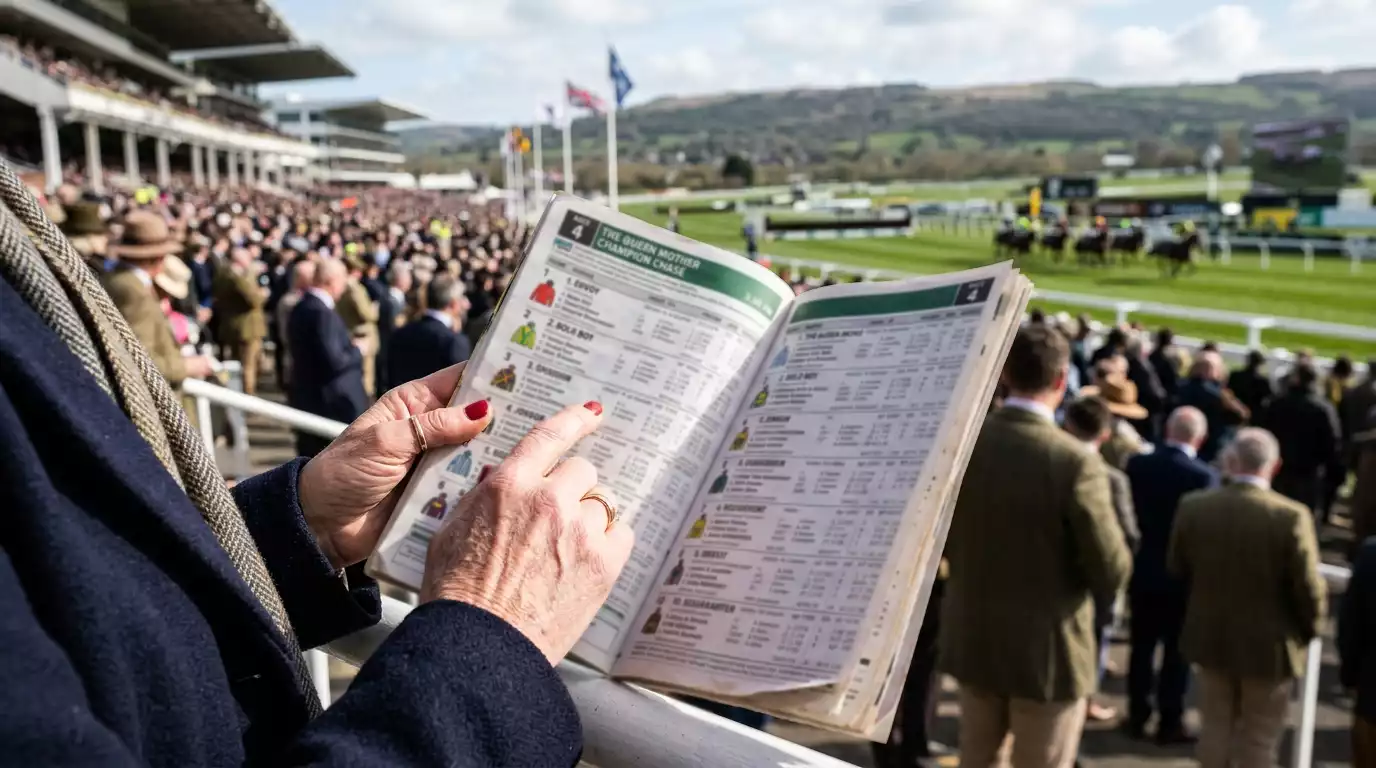
The Racecard Packs More Data Than Most Punters Unlock
I once sat next to a man at Sandown who had been coming to the races for thirty years. He was staring at the racecard, and I asked him what the “CD” next to a horse’s name meant. He shrugged. “Something to do with the course, I think.” He was half right. CD means the horse has both won at the course and over the distance. That single abbreviation — two letters — tells you the horse has proven it handles this track’s layout and this trip’s demands. My neighbour had been overlooking a crucial piece of data for three decades.
The racecard is the most information-dense document in horse racing. Every runner’s history, connections, equipment, and conditions are compressed into a grid of numbers, letters, and symbols. In 2025, 68% of racecourse visitors were casual or first-time attendees — people for whom the racecard might as well be written in code. This guide decodes it. Once you can read a racecard fluently, the form study that separates sharp bettors from casual punters takes minutes rather than hours.
Core Racecard Fields: Draw, Weight, Form, Age
Every racecard, whether printed at the course or displayed online, contains a standard set of fields for each runner. The layout varies by provider, but the data is consistent.
The draw number appears in flat races only and indicates the horse’s starting position in the stalls. Draw 1 is closest to the inside rail; higher numbers are further out. On straight courses, the draw can determine which part of the track a horse races on, and in big-field sprints it is one of the most important factors in the race. On round courses, low draws generally offer a positional advantage because the horse covers less ground to the first bend.
Weight is displayed in stones and pounds. In handicaps, each horse carries a weight determined by its official rating — higher-rated horses carry more. In non-handicap races, the weights are set by the conditions of the race, often based on age and sex. A three-year-old filly might receive a weight allowance (known as a sex allowance) when racing against colts. Jockey allowances also affect the carried weight: an apprentice or conditional jockey may claim a weight reduction (typically 3 lb, 5 lb, or 7 lb) depending on their experience level.
Form figures appear as a string of numbers and letters. The most recent run is on the far right. A “1” means first place, “2” second, and so on. A “0” represents a finish outside the first nine. Letters indicate non-completions: F (fell), U (unseated), P (pulled up), R (refused), B (brought down), C (carried out). A hyphen separates different seasons.
Age is straightforward but important. In flat racing, a two-year-old carries less weight than a three-year-old in age-weighted races. In National Hunt, most horses do not begin hurdling until age four and chasing until five. A young horse in its first season over fences is inherently more likely to make jumping errors, which is reflected in higher odds but also higher risk.
Headgear and Equipment Codes: b, v, t, p
Alongside some horses’ names you will see lowercase letters that indicate equipment the horse is wearing. These are not cosmetic — each piece of headgear serves a specific purpose, and changes in equipment are significant betting signals.
The letter “b” means blinkers — a hood with cups that restrict the horse’s rear and sideways vision, focusing its attention forward. Blinkers are used on horses that are easily distracted or tend to hang towards other runners. First-time blinkers carry a notably higher strike rate than the overall average across all handicap races, because the equipment change often delivers an immediate improvement. With the total number of horses in training falling to 21,728 in 2025, trainers are under pressure to maximise every runner’s potential, and headgear changes are one of the tools they use.
A “v” indicates a visor — similar to blinkers but with a slit cut in each eye cup, allowing some peripheral vision. Visors are a softer option for horses that need focus but may overreact to full blinkers. “p” denotes cheekpieces, which are strips of sheepskin attached to the bridle that limit downward vision and reduce the horse’s tendency to look at shadows or markings on the ground. “t” means a tongue tie — a strap that holds the horse’s tongue in place to prevent it from swallowing it during exercise, which can obstruct breathing.
The critical thing to watch for is changes. A horse wearing blinkers for the tenth time in a row is not news — the equipment is part of its routine. A horse wearing blinkers for the first time is an active decision by the trainer to try something different, and that decision carries information about the horse’s recent home work and the trainer’s expectations.
Owner, Trainer, and Jockey Columns: What to Cross-Reference
The connections listed on the racecard — owner, trainer, jockey — are more than administrative details. Each pairing tells a story, and the stories that repeat are the ones worth betting on.
Trainer form is the first thing I check. A trainer in form — multiple winners in the past fourteen days — is sending out fit, well-prepared horses. A trainer in a cold spell might be dealing with a virus in the yard, a string that is not peaking, or simply a run of tough draws. The racecard does not show trainer form directly, but every major racing website publishes it alongside the card.
Jockey bookings carry weight, particularly when a top jockey takes an unusual ride. If a leading flat jockey who normally rides for one of the big Newmarket stables takes a single booking for a small yard at a midweek Wolverhampton meeting, that choice is telling. Top jockeys have access to the best information in the weighing room, and their presence on an unexpected horse is a quiet signal of confidence.
The owner column matters less for betting analysis but is occasionally relevant. Certain owners are known for targeting specific races — a powerful owner with a string of well-handicapped horses aimed at a particular meeting is worth noting. More practically, the owner’s silks (colours) help you identify your horse during the race, which sounds trivial but makes live viewing significantly more engaging.
Cross-referencing these connections takes practice, but it compounds your edge. A horse with a trainer in form, a first-time headgear change, a leading jockey booked, and a drop in class is ticking multiple boxes simultaneously. No single factor guarantees success, but the convergence of positive signals raises the probability. That is what the racecard gives you when you know how to read it — not a prediction, but a structured basis for making smarter betting decisions.
Frequently Asked Questions
What do the letters next to a horse’s name on a racecard mean?
Lowercase letters indicate equipment the horse is wearing. The most common are: b (blinkers), v (visor), p (cheekpieces), t (tongue tie), h (hood), and e/s (eye shield). Capital letters like C and D next to the horse’s name indicate the horse has won at the course (C), over the distance (D), or both (CD). BF means the horse was a beaten favourite last time out.
How do I use a racecard to inform my bet?
Start with the form figures to see recent race history, then check the weight and draw for structural advantages. Look at headgear changes — first-time blinkers in particular — and trainer and jockey form. Cross-reference these elements: a horse with strong form, a favourable draw, a leading jockey booked, and a trainer in good form is ticking multiple positive boxes. The racecard gives you the raw data; the analysis is in connecting the dots.
Published by the Horse bet Racing team.